
Washington Native Bee Society

Alkali Bees
Nomia melanderi
There are many native bee spectacles the world over, yet few compare to what happens every early summer in a quiet agricultural valley in southeast Washington. This is one of the world's premier alfalfa seed production locations, with deep green fields of purple blooms stretching to the horizon.

To grow afalfa seed in large scale, pollination is required. Alfalfa requires bees for pollination and there is no better bee for the job than the native alkali bee, Nomia melanderi.


But there's something unique about raising alkali bees for this purpose. Unlike honey bees, which nest in a portable hive, or cavity-nesting bees that nest in hollow tubes, alkali bees nest in the ground. Salty ground that is, with just the right moisture content.


which the farmers lovingly raise by the millions. But this is no "ordinary" managed bee species–the alkali bee doesn't use hives, reeds, or tubes, rather it nests in the ground.
which the farmers lovingly raise by the millions. But this is no "ordinary" managed bee species–the alkali bee doesn't use hives, reeds, or tubes, rather it nests in the ground.
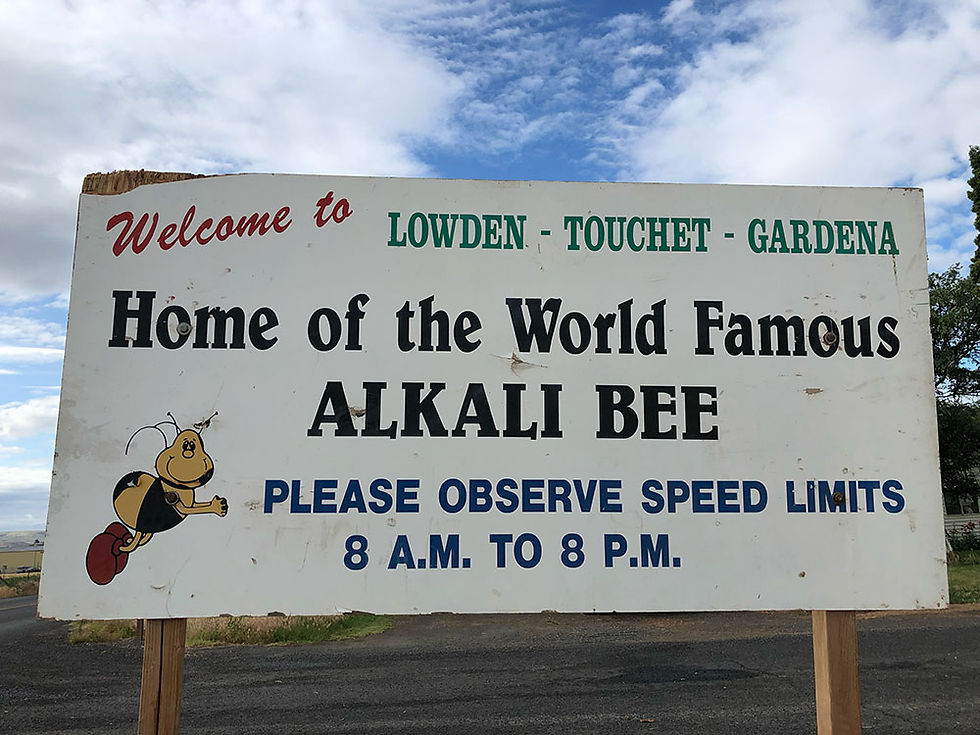
The destination are the towns of Lowden, Touchet and Gardiner. This location provides the ideal conditions for growing alfalfa seed. In the 1950's, an entomologist from Washington State University, Dr. Phil Torchio, discovered that a native pollinator was present in the area that could pollinate the alfalfa seed productively.


We are governed by a dedicated board of directors who volunteer their time and expertise to further our mission of protecting and promoting native bees. Learn more about this dynamic team.

Given to outstanding volunteers who have made a difference for native bees in Washington State. Learn about Don Rolfs and recipients of the award.
Add paragraph text. Click “Edit Text” to update the font, size and more. To change and reuse text themes, go to Site Styles.

What's your passion for pollinators?
There is much work to be done to preserve, restore, and enhance pollinator habitat throughout Washington State. Perhaps you have an idea or a project, or you might be interested in joining us. We welcome all those who dream of enhancing our state's natural beauty. Join us!

Bee habitat: Yellow sand verbena at West Beach, Deception Pass State Park
Beaches aren't always where people go to find flowers in Washington State. However, a stroll along many Washington beaches will yield a surprising amount of botany and pollinators. Here is yellow sand verbena (Abronia latifolia) blooming amongst the driftwood. Careful inspection of any patch of this flower will yield many native bees, including very energetic digger bees (Anthophora spp.).